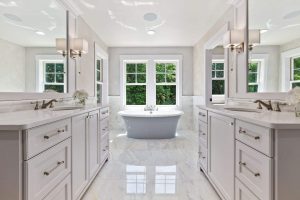
Choosing the best flooring for bathrooms means finding a surface that can withstand moisture, splashes, regular cleaning and everyday wear. Bathroom flooring must be practical and durable, but it should also feel comfortable underfoot, look attractive and suit your budget.
Porcelain tiles, ceramic tiles, luxury vinyl and natural stone are popular options, each offering different benefits. Some materials provide excellent water resistance, while others are more comfortable, affordable or easier to install.
The right choice depends on the size of your bathroom, how often it is used, the amount of water that reaches the floor and the level of maintenance you can manage. A busy family bathroom may need a different solution from a small guest bathroom or a modern wet room.
This guide examines the best bathroom flooring options, their advantages and disadvantages, installation requirements, maintenance needs and costs. It also explains what to consider before buying so you can choose flooring that works well for your home.
What Makes A Good Bathroom Floor?
Bathrooms create conditions that can damage unsuitable flooring. Water regularly reaches the floor around baths, showers and basins, while steam and temperature changes can affect certain materials.
A good bathroom floor should meet several important requirements.
- Water resistance: The surface should cope with the amount of moisture expected in the room. Areas around showers and baths require particular attention.
- Slip resistance: A floor should provide suitable grip when wet, especially where people walk barefoot.
- Durability: The material should withstand daily foot traffic, cleaning products and ordinary household use.
- Easy maintenance: Flooring that is simple to clean can help reduce the time spent removing soap residue, dust and everyday marks.
- Comfort: Some materials feel warmer and softer underfoot than others, which can be useful during colder months.
- Appearance: The flooring should complement bathroom fittings, wall finishes, storage units and lighting.
- Installation requirements: Certain products need specialist adhesives, careful subfloor preparation or a dedicated waterproofing system.
- Long-term value: Consider maintenance, repairs and replacement costs alongside the initial purchase price.
It is also important to distinguish between a waterproof floor covering and a waterproof bathroom. Water can pass through joints, gaps and poorly sealed edges, potentially damaging the subfloor even when the visible surface resists moisture.
In shower areas and wet rooms, the waterproofing beneath the finished surface is particularly important. Correct installation and suitable drainage help protect the building from water damage.
Best Flooring For Bathrooms: Comparing Popular Materials
Different flooring materials suit different budgets, bathroom layouts and household needs.
| Flooring type | Main advantage | Main drawback | Best suited to |
|---|---|---|---|
| Porcelain tiles | Low water absorption and excellent durability | Hard and potentially cold | Busy family bathrooms |
| Ceramic tiles | Wide choice of designs and prices | Some products can chip or crack | Budget-friendly renovations |
| Luxury vinyl flooring | Comfortable and available in many styles | Quality and installation requirements vary | Everyday bathrooms |
| Sheet vinyl | Can minimise the number of floor joints | Requires careful fitting | Small bathrooms |
| Natural stone | Distinctive patterns and textures | May need sealing and specialist care | Premium interiors |
| Waterproof laminate | Attractive wood-effect finishes | Not all products suit wet environments | Approved bathroom installations |
| Terrazzo | Decorative and versatile appearance | Can involve specialist installation | Contemporary designs |
| Cork | Softer feel underfoot | Requires suitable moisture protection | Bathrooms with controlled moisture exposure |
These comparisons are general guidelines. The quality, surface finish and installation method of a specific product can significantly affect its performance.
Porcelain Tiles For Durable Bathroom Flooring
Porcelain tiles are among the most practical options for bathrooms because they are dense, durable and have very low water absorption.
They are manufactured from refined clay and other materials fired at high temperatures. The result is a hard surface that can withstand regular cleaning and everyday foot traffic.
Porcelain flooring is available in a wide range of colours, sizes and finishes. Some products imitate marble, slate, concrete or timber, allowing you to achieve different styles without using those materials.
The main advantages include:
- Low water absorption.
- Good resistance to everyday wear.
- A wide choice of colours, patterns and textures.
- Straightforward cleaning with suitable products.
- Compatibility with many underfloor heating systems when installed correctly.
Porcelain tiles work particularly well in family bathrooms where the floor is frequently exposed to water.
However, the surface finish is important. Polished tiles may become slippery when wet, so they are not automatically suitable for every bathroom area.
For shower floors, choose tiles specifically designed for wet barefoot conditions. Smaller tiles may provide more grout joints, which can contribute to grip, but the tile’s actual slip resistance and the complete installation still matter.
Porcelain is also hard and can feel cold underfoot without heating. Dropped bottles or glass containers may break when they land on it.
Grout joints need attention too. Although porcelain absorbs very little water, grout can collect dirt and soap residue. Appropriate grout selection and regular cleaning help keep the floor looking its best.
For homeowners who want a durable, low-maintenance surface, porcelain is a strong all-round choice.
Ceramic Tiles For An Affordable Bathroom Floor
Ceramic tiles offer another practical option for bathroom flooring. They are made from clay and other natural materials, then fired to create a hard surface. Many products have a glazed finish that provides colour and helps protect against stains.
They are available in numerous designs, including plain neutral colours, decorative patterns and stone-effect finishes.
Ceramic tiles can be less expensive than some porcelain products and are generally easy to clean. When correctly selected and installed, they can perform well in ordinary bathroom conditions.
However, some ceramic tiles are more vulnerable to chipping or cracking after heavy impacts. Their performance depends on the product’s construction and intended use.
It is essential to check that the tile is rated for floor installation. Wall tiles are not necessarily strong enough to withstand regular foot traffic, and some floor tiles may not provide adequate grip for wet areas.
Ceramic flooring can also feel cold and hard, while grout joints may require regular cleaning.
Before buying, check the manufacturer’s recommendations for bathroom use, slip resistance and cleaning. If the tiles will be installed inside a shower, confirm that they are suitable for that specific application.
Ceramic is worth considering if you want a tiled finish while keeping material costs under control.
Luxury Vinyl Flooring For Comfort And Everyday Use
Luxury vinyl flooring is popular because it combines a wide range of designs with a relatively comfortable feel underfoot.
It is available in planks and tiles that imitate wood, stone and decorative patterns. Luxury vinyl tile, commonly known as LVT, can be installed using glue-down or click-lock systems, depending on the product.
Some rigid-core vinyl products have a firmer construction designed to improve stability.
The advantages include:
- A softer feel than most ceramic and porcelain tiles.
- A wide range of colours and patterns.
- Easy cleaning with suitable household products.
- Good resistance to everyday splashes when the product is approved for bathroom use.
- A variety of installation systems.
Vinyl can be useful in bathrooms where comfort, design flexibility and convenient maintenance are priorities.
However, product quality varies. Some vinyl floors can be damaged by sharp objects, heavy furniture or unsuitable cleaning products.
Water resistance also depends on the complete installation. A waterproof surface does not guarantee that water cannot pass through joints or edges and affect the subfloor.
Check the manufacturer’s guidance before purchasing, particularly if the bathroom contains a walk-in shower or regularly experiences standing water. Not every click-lock product is suitable for wet rooms or shower areas.
The subfloor must also be smooth, stable and prepared according to the installation instructions. Unevenness can affect the finished appearance and performance.
For an ordinary bathroom, quality vinyl approved for the intended conditions can offer a useful balance between comfort and practicality.
Sheet Vinyl For Small Bathrooms
Sheet vinyl comes in large rolls rather than separate tiles or planks. Depending on the room’s dimensions, it may be possible to cover most or all of the floor with a single piece.
This can reduce the number of joints where water might enter. However, seams, edges and openings around pipes still need to be fitted and sealed appropriately.
Sheet vinyl is available in many styles, including wood-effect, stone-effect and patterned designs.
Its advantages include a relatively soft feel underfoot, easy routine cleaning and the potential for fewer visible joints than tiled flooring.
It can be particularly practical in small bathrooms with straightforward layouts.
The main challenge is installation. The subfloor needs to be smooth because bumps and imperfections may show through the finished surface. Incorrect fitting can also create gaps or allow water to reach the materials underneath.
Sheet vinyl may be vulnerable to cuts and punctures, so care is needed when moving heavy furniture or appliances.
Choose a product specifically approved for bathroom use and follow the manufacturer’s instructions for fitting, cleaning and moisture protection.
Natural Stone For A Premium Bathroom Design
Natural stone flooring can give a bathroom a distinctive appearance because individual tiles contain their own patterns, markings and colour variations.
Popular options include marble, granite, slate and limestone. Each material has different characteristics, so it is important to choose one that suits the room.
Natural stone can be durable when correctly selected, installed and maintained. It can also complement a wide range of styles, from traditional bathrooms to contemporary interiors.
However, stone often requires more care than manufactured flooring.
Marble and limestone can be affected by acidic substances found in certain cleaning products. Some stones are porous and may need periodic sealing to help protect against moisture and staining.
Before buying natural stone, consider:
- Whether the material requires sealing.
- Which cleaning products are safe for the specific stone.
- Whether the surface provides suitable grip when wet.
- How much variation exists between individual tiles.
- Whether the subfloor can support the finished floor’s weight.
Natural stone can also cost more than ceramic or porcelain tiles, particularly when specialist cutting and installation are required.
Costs vary by location, materials, labour, property size and project requirements. Complex layouts and additional preparation can increase the final price.
Stone is a good option for homeowners who value natural materials and are prepared to follow the recommended maintenance routine.
Waterproof Laminate Flooring In Bathrooms
Laminate flooring is commonly used to create a wood-effect finish at a relatively affordable price. It typically has a decorative surface over a core containing compressed wood-based material.
Some modern products are designed with enhanced water resistance and are approved for particular bathroom applications.
However, traditional laminate can be damaged when moisture enters through the joints or edges. The core may swell, causing boards to lift or the surface to become uneven.
Even products marketed as waterproof have limitations. A manufacturer’s warranty may cover ordinary bathroom use but exclude wet rooms, shower enclosures or prolonged standing water.
If you prefer laminate, check the exact product specification and confirm that it is approved for your bathroom conditions.
Follow the installation instructions for perimeter gaps, edge protection and cleaning. Avoid leaving water on the surface, even when the product has enhanced moisture resistance.
For bathrooms that experience frequent splashes or standing water, porcelain tiles or a suitable vinyl product may be a more practical alternative.
Terrazzo Flooring For A Decorative Bathroom
Terrazzo is made by combining small pieces of materials such as marble, glass or other aggregates with a cement-based or resin-based binder. The finished surface reveals the decorative particles within the material.
It can create a distinctive floor with a variety of colours and patterns, making it suitable for both modern and traditional bathroom designs.
Depending on the construction and finish, terrazzo can provide a durable surface. However, installation and maintenance requirements vary between products.
Cement-based terrazzo may require sealing, while resin-based versions have their own care requirements. The surface finish also affects how suitable the floor is for wet barefoot use.
Terrazzo can be expensive, especially when a poured system requires specialist labour. Terrazzo-look tiles may provide a similar visual effect at a different price point, although they are not the same material.
Before choosing this flooring, check its suitability for bathrooms, its slip resistance and the manufacturer’s cleaning recommendations.
How To Choose Bathroom Flooring For Different Needs
The best flooring depends on the people using the bathroom, the layout and how much water reaches the floor.
For busy family bathrooms, porcelain tiles and suitable vinyl are practical options. Porcelain provides a hard-wearing surface, while vinyl may feel more comfortable for children getting ready in the morning.
For small bathrooms, light-coloured tiles or vinyl can help the room feel brighter. Larger tiles or sheet flooring may also create a less busy appearance by reducing visible joints.
For ensuite bathrooms, consider how the flooring will look alongside the adjoining bedroom. Wood-effect vinyl or porcelain can create visual continuity without using real timber in a moisture-prone space.
For older adults or people with limited mobility, slip resistance deserves particular attention. Select flooring suitable for wet barefoot use and consider how it works with the shower design, drainage and any accessibility features. No flooring material can remove every risk of slipping.
For luxury bathrooms, natural stone or terrazzo may create the desired finish, provided the maintenance requirements fit your household.
For rental properties, practical and easy-to-clean materials may be preferable to products requiring specialist care. Consider the property owner’s requirements and the total installation budget before deciding.
How Much Does Bathroom Flooring Cost?
The cost of bathroom flooring depends on the material, product quality, room dimensions and complexity of the installation. Prices vary by location, materials, labour, property size and project requirements.
The total budget should include more than the flooring itself.
Potential expenses include:
- Removing and disposing of the existing floor.
- Repairing or levelling the subfloor.
- Installing a suitable waterproofing system where required.
- Buying adhesive, grout, underlay and finishing materials.
- Cutting flooring around pipes, toilets and bathroom furniture.
- Replacing damaged skirting boards or trims.
- Adjusting doors if the finished floor height changes.
- Installing underfloor heating, if required.
- Repairing damaged sections of the subfloor.
Waterproofing is particularly important around showers and wet rooms. It should be included in the project plan rather than treated as an optional extra.
When comparing quotes, check whether the installer includes preparation, waterproofing, finishing and waste disposal. A lower initial price may exclude work needed for a reliable installation.
Measure the floor carefully and ask how much additional material is required for cuts and future repairs.
Obtaining more than one written quote can help you compare costs, provided each quote covers similar materials and work.
How To Maintain Bathroom Flooring
Regular cleaning and prompt attention to leaks can help keep a bathroom floor in good condition.
Sweep or vacuum to remove dust and loose particles before mopping. Grit can scratch some surfaces when walked across.
Use cleaning products suitable for the flooring material. Strong chemicals and abrasive pads may damage certain finishes, particularly natural stone and some vinyl products.
After bathing or showering, remove excess water where practical and ensure the room is adequately ventilated. This helps control persistent moisture and reduces the likelihood of mould developing in surrounding areas.
Inspect the sealant around baths, showers and basins periodically. Damaged sealant can allow water to enter gaps beneath the flooring or behind fittings.
For tiled floors, check grout joints and repair damaged sections when necessary. Follow the manufacturer’s guidance about sealing, especially with natural stone.
For vinyl, avoid sharp objects and unsuitable solvents. For waterproof laminate, clean up standing water promptly and follow the product’s specific care instructions.
If the floor becomes loose, develops raised edges or shows signs of water damage, investigate the cause rather than simply covering the affected area.
Common Bathroom Flooring Mistakes To Avoid
Even a good flooring product can perform poorly if it is unsuitable for the room or incorrectly installed.
Avoid these common mistakes:
- Choosing a polished surface without checking its slip resistance.
- Assuming all vinyl or laminate products are suitable for showers and wet rooms.
- Ignoring the need for waterproofing beneath the finished surface.
- Installing flooring over an uneven, unstable or damp subfloor.
- Using wall tiles on the floor without confirming their suitability.
- Cleaning natural stone with products that can damage the surface.
- Failing to finish edges and joints correctly.
- Comparing material prices without including preparation and fitting costs.
Before buying, check the product specifications and discuss installation requirements with a qualified installer if you are unsure.
Frequently Asked Questions
What Is The Best Flooring For Bathrooms Overall?
Porcelain tiles are a strong all-round choice because they have low water absorption and are highly durable. Quality bathroom-approved vinyl is another practical option, particularly if comfort and easy cleaning are priorities. The right choice depends on your budget and bathroom layout.
What Is The Most Waterproof Bathroom Flooring?
Porcelain tiles have very low water absorption, while certain vinyl products provide waterproof surfaces. However, the complete installation matters. Waterproofing beneath the finish, properly sealed edges and suitable drainage are important in areas exposed to substantial amounts of water.
Is Vinyl Or Tile Better For A Bathroom?
Vinyl generally feels softer and warmer underfoot, while porcelain and ceramic tiles provide a hard, durable surface. Vinyl can be practical for everyday bathrooms, whereas tiles may suit households seeking a long-lasting tiled finish. Slip resistance and suitability for wet conditions should guide the decision.
Can You Use Laminate Flooring In A Bathroom?
Some laminate products are approved for bathroom use, but traditional laminate can be damaged by moisture. Check the manufacturer’s instructions and warranty carefully. For shower areas and wet rooms, choose a flooring system specifically designed for those conditions.
What Is The Best Bathroom Flooring For Small Spaces?
Light-coloured porcelain tiles, ceramic tiles and suitable vinyl can work well in small bathrooms. Larger tiles or flooring with fewer visible joints may create a more continuous appearance. Consider the room’s lighting, wall colours and layout before choosing a finish.
Do Bathroom Floors Need Waterproofing?
The requirements depend on the room layout, flooring system and amount of water exposure. Shower areas and wet rooms generally need an appropriate waterproofing system beneath the finish. Follow applicable building requirements and the manufacturer’s installation guidance.
Conclusion
Choosing the best flooring for bathrooms involves balancing water resistance, slip resistance, durability, comfort, appearance and cost. Porcelain tiles are an excellent choice for many bathrooms, while ceramic tiles provide a practical alternative and quality vinyl offers a softer, comfortable surface.
Natural stone and terrazzo can create distinctive designs, but they may require additional maintenance. Waterproof laminate should only be used when the specific product is approved for the intended bathroom conditions.
Before making a decision, consider how the room is used, how much water reaches the floor and what maintenance you can manage. Check the product specifications, budget for proper subfloor preparation and ensure the installation includes the waterproofing needed for the space.
With careful planning and suitable materials, you can create a bathroom floor that complements your home, handles everyday moisture and remains practical for years to come.