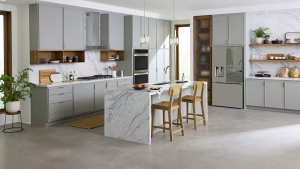
Choosing the best flooring for kitchens means finding a surface that can handle spills, frequent cleaning, heavy appliances and everyday foot traffic without compromising on appearance. A kitchen floor should be durable, easy to maintain, comfortable underfoot and suitable for your budget.
The right choice depends on how you use your kitchen, the style of your home and the amount of maintenance you are prepared to undertake. Porcelain tiles, luxury vinyl, ceramic tiles, engineered wood and laminate flooring each offer different benefits.
Some materials provide excellent moisture resistance, while others create a warmer, more natural appearance. Understanding these differences can help you avoid expensive mistakes and choose a floor that performs well for years.
This guide explains the main kitchen flooring options, their advantages and disadvantages, installation considerations, maintenance requirements and the questions to ask before buying.
What To Consider When Choosing Kitchen Flooring
Kitchen floors face different challenges from those in bedrooms or living rooms. Water can splash around the sink, cooking oil can stain certain surfaces, and chairs or appliances can scratch poorly protected materials.
Before choosing a product, consider the following factors.
- Water resistance: The flooring should cope with everyday splashes and spills. Areas around sinks, dishwashers and washing machines need particular attention.
- Durability: Consider how well the surface handles foot traffic, furniture, dropped utensils and the movement of appliances.
- Slip resistance: A floor can become hazardous when wet. Choose a finish with suitable grip for domestic kitchen use.
- Maintenance: Some materials need sealing or specialist cleaning products, while others require little more than sweeping and mopping.
- Comfort: If you spend a long time preparing meals, a softer surface may feel more comfortable than a hard tiled floor.
- Appearance: Consider how the flooring will complement your cabinets, worktops, walls and adjoining rooms.
- Installation: Some products require a professionally prepared subfloor, specialist adhesives or precise fitting.
- Long-term value: Look beyond the initial purchase price and consider cleaning, repairs, maintenance and eventual replacement.
Your existing floor also matters. An uneven, unstable or damp subfloor can affect the performance of new flooring, so it should be inspected before installation.
Best Flooring For Kitchens: Comparing The Main Options
Several materials work well in kitchens, but each suits different priorities.
| Flooring material | Main benefit | Main drawback | Best for |
|---|---|---|---|
| Porcelain tiles | Excellent durability and low water absorption | Hard and cold underfoot | Busy kitchens |
| Luxury vinyl flooring | Comfortable and versatile | Quality varies between products | Everyday family use |
| Ceramic tiles | Practical and available in many designs | Can chip or crack after impacts | Budget-conscious tiled kitchens |
| Engineered wood | Natural timber appearance | Sensitive to prolonged moisture | Stylish open-plan spaces |
| Natural stone | Unique patterns and textures | Can require sealing and specialist care | Premium kitchen designs |
| Laminate | Affordable wood-effect finishes | Some products are vulnerable to water | Lower-cost renovations |
| Solid hardwood | Can be refinished | Expands and contracts with moisture changes | Carefully maintained kitchens |
| Cork | Softer feel underfoot | Needs appropriate moisture protection | Comfort-focused kitchens |
These comparisons are general guidelines. The quality, surface finish and installation requirements of individual products can make a considerable difference.
Porcelain Tiles For Long-Lasting Kitchen Flooring
Porcelain tiles are among the strongest options for homeowners who prioritise durability and moisture resistance. They are manufactured from refined clay and fired at high temperatures, creating a dense material with low water absorption.
They are available in a wide range of colours, sizes and finishes. Some designs reproduce the appearance of timber, marble, limestone or concrete, making it possible to achieve different styles without using those materials.
The main advantages of porcelain flooring include:
- Strong resistance to everyday wear and scratches.
- Low water absorption.
- A broad choice of colours, patterns and textures.
- Straightforward cleaning with suitable products.
- Compatibility with many underfloor heating systems when installed according to the manufacturer’s instructions.
Porcelain tiles are particularly useful in kitchens that experience frequent spills or heavy foot traffic.
However, they have disadvantages. The surface is hard, so dropped plates and glasses are more likely to break. Standing for long periods can also feel tiring, and the floor may feel cold without underfloor heating.
The finish deserves careful consideration. Some polished tiles become slippery when wet, so choose a surface with suitable slip resistance rather than relying on appearance alone.
Grout joints also require attention. The tiles may absorb very little water, but grout can collect dirt and stains if it is not properly installed and maintained.
For a busy household seeking a hard-wearing floor with relatively simple maintenance, porcelain is a strong choice.
Luxury Vinyl Flooring For Everyday Practicality
Luxury vinyl flooring is popular because it combines a wide range of designs with a relatively comfortable feel underfoot. It is available in planks, tiles and other formats, with styles that imitate wood, stone and decorative patterns.
Luxury vinyl tile, commonly known as LVT, is available in glue-down and click-lock systems. Rigid-core vinyl products are another option, with different constructions affecting their stability, comfort and installation requirements.
Benefits include:
- A softer feel than most ceramic and porcelain tiles.
- A wide selection of colours and patterns.
- Easy routine cleaning.
- Good resistance to everyday spills when the product is suitable for kitchen use and correctly installed.
- Options that can be simpler to replace than a complete tiled floor.
Vinyl can be particularly useful in family kitchens where comfort and convenience matter.
Nevertheless, not all vinyl flooring offers the same performance. Lower-quality products may mark, fade or wear more quickly. Heavy appliances can also leave indentations in some materials, especially when they are moved without suitable protection.
Check the manufacturer’s instructions before installation. The subfloor usually needs to be smooth and stable, and certain products require specific underlays or adhesives.
It is also important to understand the difference between a waterproof surface and a waterproof installation. Water may still pass through joints, edges or gaps and damage the underlying floor.
For many households, quality luxury vinyl provides an effective balance between appearance, comfort and maintenance.
Ceramic Tiles For Affordable Kitchen Floors
Ceramic tiles offer another practical option for kitchens. They are manufactured from clay and other natural materials, then fired to create a hard surface. Many products have a glazed finish that helps protect against stains and gives the tile its colour.
Ceramic tiles are available in traditional patterns, contemporary designs and simple neutral shades. This makes them suitable for a wide range of kitchen styles.
Their advantages include good resistance to everyday spills, straightforward cleaning and a broad choice of prices and finishes.
However, ceramic tiles may be more susceptible to chipping or cracking from heavy impacts than some porcelain products. Performance depends on the specific tile, its thickness and its intended use.
They can also feel cold and hard underfoot. Grout lines may require regular cleaning, particularly in areas where food and cooking liquids are frequently spilled.
Always select tiles specifically rated for floor use. Wall tiles are not necessarily strong enough to withstand the weight and pressure associated with foot traffic.
Ceramic flooring is worth considering if you want the appearance and practicality of tiles without choosing a premium porcelain product.
Engineered Wood For A Natural Kitchen Design
Engineered wood flooring consists of a real wood surface attached to a layered core. Its construction is designed to improve dimensional stability compared with solid timber, although results vary between products.
It offers the appearance of natural wood, including the grain and colour variations that make timber attractive. Oak, walnut and other finishes can create a warm atmosphere in both traditional and contemporary kitchens.
Advantages include:
- Genuine wood grain and texture.
- Different plank sizes and colours.
- A natural appearance that can connect kitchen and living areas.
- Compatibility with some underfloor heating systems when the product is approved for them.
The main disadvantage is its sensitivity to moisture. Water that enters through joints or remains on the surface can cause swelling, staining or other damage.
Engineered wood should not automatically be considered waterproof simply because it has a layered construction.
If you choose this material, look for a product approved for kitchen use and follow its installation and maintenance instructions. Wipe up spills promptly and take extra care around sinks, dishwashers and plumbing connections.
Engineered wood is best suited to homeowners who value natural timber and are willing to manage the additional maintenance it may require.
Natural Stone For A Distinctive Finish
Natural stone flooring can give a kitchen a distinctive appearance because every tile may have its own patterns, markings and colour variations.
Popular options include slate, limestone, marble and granite. Each has different characteristics, so choosing the right stone requires more consideration than simply selecting a colour.
Natural stone can be durable, but its performance depends on the type of stone, surface finish, installation and maintenance.
For example, marble and limestone can react with acidic substances found in certain foods and cleaning products. More porous stones may absorb liquids and require suitable sealing.
Before purchasing stone flooring, consider:
- Whether it needs sealing before or after installation.
- Which cleaning products are safe for the material.
- How the surface performs when wet.
- Whether the tiles vary significantly in thickness or appearance.
- Whether the existing subfloor can support the finished floor.
Natural stone can also involve higher material and installation costs than many manufactured alternatives.
Costs vary by location, materials, labour, property size and project requirements. Complex layouts, specialist preparation and premium stone selections can increase the total.
Stone is a suitable choice for homeowners who want a distinctive, long-lasting finish and are prepared to maintain it properly.
Laminate Flooring For Budget-Conscious Renovations
Laminate flooring creates a wood-effect or stone-effect appearance using a decorative layer protected by a wear surface. Many products have a compressed wood-based core and a click-lock fitting system.
Its main attraction is affordability. It can provide the look of timber without the purchase price of solid hardwood or engineered wood.
Laminate is generally easy to clean, and its many designs make it suitable for different kitchen interiors.
However, moisture resistance varies considerably between products. Some modern laminates are designed to withstand spills for a specified period, while others can swell if water reaches the core.
Pay particular attention to joints, edges and areas around appliances. Even a product marketed as water-resistant may have limitations if water remains on the surface or enters through an opening.
If you choose laminate for a kitchen, select one specifically approved for that environment. Follow the manufacturer’s instructions about cleaning, perimeter gaps and spill management.
Unlike solid hardwood, laminate generally cannot be sanded and refinished. Serious damage to the decorative surface usually means replacing the affected boards.
Laminate can be a reasonable option for a lower-cost renovation, provided its moisture limitations are understood.
Solid Hardwood Flooring For A Traditional Kitchen
Solid hardwood flooring is made from a single piece of timber and offers a classic appearance. Oak, maple and other timber species have different colours, grain patterns and hardness levels.
One advantage is that certain solid wood floors can be sanded and refinished, allowing the surface to be renewed when it becomes worn.
However, kitchens expose timber to moisture, temperature changes and spills. Wood can expand, contract, develop gaps or become stained when conditions change.
Standing water and plumbing leaks are particularly problematic. A protective finish helps but does not make solid wood waterproof.
If you prefer solid hardwood, consider whether you can clean spills quickly, maintain the finish and monitor the kitchen for leaks. Correct installation, including suitable expansion gaps, is essential.
Solid hardwood may work well in a carefully maintained kitchen, but it is not necessarily the most practical option for every household.
Cork Flooring For Better Underfoot Comfort
Cork flooring is made from the bark of cork oak trees. Its cellular structure gives it a naturally resilient feel, making it softer underfoot than many tiled surfaces.
This can be helpful for people who spend long periods standing while cooking or preparing food. Cork also provides insulation, which may help the floor feel more comfortable.
It is available in several colours and finishes, including natural patterns and more contemporary designs.
However, cork can be vulnerable to scratches, dents, sunlight and moisture, depending on the product and protective coating.
For kitchen use, choose a product specifically approved for the room and follow the manufacturer’s guidance on sealing and cleaning.
Cork is worth considering when comfort is a priority, but it may not be the best choice for a kitchen that regularly experiences standing water or heavy wear.
How To Choose Kitchen Flooring For Your Household
The best option depends on the way your kitchen is used rather than appearance alone.
For busy family kitchens, porcelain tiles and quality vinyl are practical choices. Porcelain offers a hard-wearing surface, while vinyl generally feels more comfortable underfoot.
For households with young children, look for a surface that is easy to clean and provides suitable grip when wet. Vinyl may feel less unforgiving than tile when lightweight items are dropped, although no floor makes breakages impossible.
For homes with pets, consider scratch resistance, cleaning requirements and traction. A suitable textured tile or quality vinyl may be easier to maintain than a delicate or highly polished surface.
For open-plan kitchens, engineered wood can create visual continuity between the kitchen and adjoining rooms. Wood-effect porcelain is another option if moisture resistance is a higher priority.
For small kitchens, larger tiles or wider planks may create a less busy appearance by reducing the number of visible joints. Light flooring can also help a space feel brighter, although natural light and cabinet colours affect the overall result.
For rental properties, durable and easy-to-clean materials may be a sensible choice. However, the final decision should account for the property owner’s requirements, installation budget and expected use.
How Much Does Kitchen Flooring Cost?
The total cost of kitchen flooring depends on the material, product quality, floor area and complexity of the installation. Prices also vary by location, materials, labour, property size and project requirements.
Rather than comparing material prices alone, calculate the likely cost of the complete project.
Include the following expenses where applicable:
- Removing and disposing of the existing floor.
- Repairing or levelling the subfloor.
- Buying underlay, adhesive, grout or moisture protection.
- Purchasing trims and finishing materials.
- Cutting tiles or planks around cupboards and doorways.
- Moving appliances and reconnecting services where necessary.
- Adjusting doors or replacing damaged skirting boards.
- Installing underfloor heating if required.
Measure the kitchen carefully and ask the supplier how much additional flooring is needed for cuts, patterns and future repairs.
Obtain more than one written fitting quote where possible. Check that each quote covers the same preparation work, materials and finishing details.
A cheaper quote may exclude important work, such as removing the old floor or levelling the base. Understanding these differences makes it easier to compare prices fairly.
How To Maintain Kitchen Flooring
Regular maintenance can help keep a kitchen floor attractive and reduce the risk of avoidable damage.
Sweep or vacuum frequently to remove grit, dust and food particles. These can scratch certain surfaces when they are walked across.
Wipe up spills promptly, particularly around sinks, fridges and dishwashers. Check for leaks occasionally, as moisture can damage both the flooring and the subfloor.
Use cleaning products recommended for the material. Strong chemicals, abrasive pads and excessive water may damage some finishes.
For tiled floors, inspect grout joints and repair damaged areas when necessary. Follow the manufacturer’s advice about sealing grout or natural stone.
For wood and laminate, avoid leaving standing water on the surface. Use protective pads under chairs and take care when moving heavy appliances.
For vinyl, choose suitable cleaning products and avoid dragging sharp objects across the floor.
A regular maintenance routine is usually more effective than waiting until visible damage develops.
Common Kitchen Flooring Mistakes To Avoid
Even a good flooring product can perform poorly if the wrong material is selected or installation requirements are overlooked.
Avoid these common mistakes:
- Choosing a finish based only on appearance without checking slip resistance.
- Installing flooring that is unsuitable for kitchen moisture.
- Ignoring an uneven or unstable subfloor.
- Assuming every vinyl or laminate product is waterproof.
- Buying wall tiles for use on the floor without checking their rating.
- Overlooking maintenance requirements for wood and natural stone.
- Forgetting to include preparation and fitting costs in the budget.
- Failing to account for changes in floor height near doorways and adjoining rooms.
Before buying, read the product specifications and confirm that the flooring is suitable for the intended room and installation method.
Frequently Asked Questions
What Is The Best Flooring For Kitchens Overall?
Porcelain tiles and quality luxury vinyl are two strong all-round options. Porcelain is well suited to durability and moisture resistance, while vinyl offers comfort, design flexibility and straightforward cleaning. The right choice depends on your budget and household needs.
What Is The Most Waterproof Kitchen Flooring?
Porcelain tiles have very low water absorption, while some vinyl products provide waterproof surfaces. However, the whole installation matters. Water can still pass through joints, edges or gaps, so correct fitting and suitable moisture protection are important.
Is Vinyl Or Tile Better For A Kitchen?
Vinyl generally feels softer and warmer underfoot, while tiles can provide excellent durability. Vinyl may suit households that prioritise comfort and ease of installation. Porcelain or ceramic tiles may be preferable when a hard-wearing surface is the main priority.
What Colour Flooring Is Best For A Kitchen?
Light oak, beige, soft grey and other neutral shades work with many kitchen styles. Light colours can help a small room feel brighter, while darker flooring can create contrast with pale cupboards. Consider the room’s lighting, worktops and cabinet colours before deciding.
Can New Flooring Be Installed Over An Existing Kitchen Floor?
Sometimes. The existing floor must be stable, clean, level and suitable for the new material. Additional floor height can affect doors, appliances and transitions between rooms. Some flooring systems require the old material to be removed, so check the manufacturer’s instructions.
How Long Does Kitchen Flooring Last?
The lifespan depends on the material, product quality, installation, maintenance and amount of use. Well-maintained porcelain tiles can last for many years, while vinyl, laminate and wood may require repairs or replacement sooner. Correct installation and prompt attention to damage help extend the life of most floors.
Conclusion
Choosing the best flooring for kitchens involves balancing durability, moisture resistance, comfort, appearance and cost. Porcelain tiles are an excellent option for busy kitchens, while quality luxury vinyl offers a practical combination of comfort, easy maintenance and design flexibility.
Ceramic tiles, engineered wood, natural stone, laminate, solid hardwood and cork can also work well when their advantages and limitations suit the household.
Before making your final decision, consider how often the kitchen is used, how much maintenance you can manage and whether the existing subfloor needs attention. Compare the full installation cost, check the manufacturer’s guidance and choose a finish suitable for kitchen conditions.
With careful planning and the right material, you can create a kitchen floor that complements your home, supports everyday activities and provides lasting value.